10.- Locomotoras Diesel (II)
Las Eurofima en Renfe, Gama U10B de General Electric
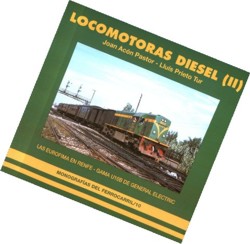 The locomotives that we present in this book have many things jointly: power lower than the 1.000 cv, they are not locomotives of line but they are not tractors of maneuvers either and they were born with the aim to obtain a standardized construction that was common to the major possible number of railway administrations. But his origin was radically different: France (040 GIVES of Brissonneau et Lortz) and the USA (The Universal series of GECo). So much in one as in another case, it allowed to RENFE to have a type of machines of median it promotes for all kinds of services: maneuvers, short trains, trains of work, etc This category of locomotives allowed to have traction to some narrow-gauge railroads (The Robla, Tajuña) and to the industrial facilities (Metallurgical and port) the north of the peninsula.
The efforts of the UIC for managing to unify criteria of construction (to cheapen the costs) to achieve a group of European locomotives was obtained only partly. But undoubtedly, the most extraordinary achievement was the construction of the French locomotive 040 DA. To support this politics, there was accompanied on the purchase of these units a system of funding of the entity Eurofima, specialized in this type of operations. Thus there was allowed an integrated European politics in the construction of railway material in a few years in which, indisputably, the kings were the North American companies. In RENFE, and without great enthusiasm, an experience was effected, first of rent and Switcher buys later, of a limited series of this type of locomotive, the European a Road-, standardized and of "Universal" type that was allowing an easy exportation. The conception of this type of locomotive had allowed to provide with traction diesel to lines and secondary branches that were not admitting excessive charges for axis. Though the series was not satisfying RENFE for technical problems and little power, they were in service approximately 30 years. Similar series continue working in France and other countries.
A locomotive of similar conception of American origin gave place to the series 10.800 of RENFE, acquaintance as the 'ye-ye'. The American range of the U10B of General Electric came to Spain to the Railroad of The Robla in 1963. This model was one of most adapted for narrow-gauge railroads and difficult tracings. The simplicity and hardness of these locomotives interested the Babcock and Wilcox of Biscay, which included it in his catalogue of construction of locomotives close to GECo's subsidiary, the GEE.
The putting in public companies' march like ENSIDESA and UNINSA, and other industrial factories were necessary locomotives of certain power and similar to GECo's U10B.
As test of the good one to do of the GECO, it is that in 1998 they continued working regularly and with some renovations of on half great report of these locomotives in the companies in those that they managed to use.
 Buy this book
Characteristics
Date of publication: 1998
Language: Spanish
Nº of pages: 182
Author: Joan Acón and Lluís Prieto.
Size: 22 X 20 X 1,5 cm.
ISBN: 84-921005-5-9