12.- Locomotoras Diesel (III)
Series 313, 314 y 319 americanas Renfe.
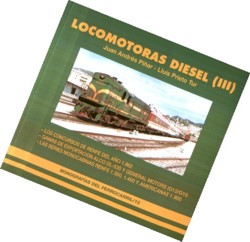 In this third volume dedicated to the locomotives diesel establishes an approximation to the motives for which RENFE decided to apply criteria of 'dieselización massive'. The experience of the locomotives ALCO 316 and 318 turned out to be positive but there existed certain doubts about continuing with the acquisition of similar models. The reality is that the plans of electrification and his associate motive power (276,277 and 278) mortgaged in certain way the financial availabilities. And there was an important change in the 60s on having be decided by a massive 'dieselización', once there were achieved the financial suitable sources. There sat down thus the bases by means of which, in the decade of the 60s and good part of 70 the situation of RENFE's motive park was offering an unusual variety for what it concerns to motive power: centenary locomotives of steam I join others of contemporary type; Locomotives diesel of different origins (Swisses, Germans and Americans) electrical locomotives of diverse origins (Americans, Frenches and English) and thermal and electrical autorails with more variation (France, Switzerland, Italy, Germany, etc.). All this was a fruit, possibly of a lack of planning. We must not forget the politics of the pro-Franco government and his need of international recognition (And of funding and foreign opening) that was necessary a series of commitments with the government of USA but without stopping of side to the European countries.
In this context both international contests of locomotives organized diesel in 1962, restricted the first one to the American builders to take advantage of the financing source of the American Help, and another contest, simultaneously to the first one, in which they could inform freely all the companies (European Americans associated with some national builder).
The first contest was solved because it was the one that had the insured funding, whereas for a series of circumstances that are detailed in this book, the second contest was annulled. This situation saved from his retreat to many locomotives of steam. Once solved the problems of funding thanks to RENFE's presence of the World Bank, it was possible to celebrate the third contest, which would give place to the numerous series ALCO 2.100 and GM 1.900. Up to his resolution one had to resort to an acquisition of urgency of new locomotives that were using as transition, so though some diurnal services were offering a worthy enough level given the epoch (Trains FIAT and TALGO), in many express trains of national and international category they remained towed by steam locomotives. These locomotives of transition were acquired by an Urgent Plan that the acquired ones extended in the first contest (1.300), there completed those of the third contest (GM G-16) and allowed the arrival of those who were the RENFE's most powerful locomotives, the series 4000. This third volume of the work treats of both contests and of the epoch of transition up to the massive dieselization of the ALCO 2.100 and GM 900 of the type J-16 (Bicabinas).
 Buy this book
Characteristics
Date of publication: 2000
Language: Spanish
Nº of pages: 186
Authors: Juan Andrés Piñar and Lluís Prieto i Tur
Size: 22 X 20 X 1.7 cm.
ISBN: 84-930930-0-9