17.- Ferrocarriles y tranvías en Linares, la Carolina y La Loma
(Sold Out)
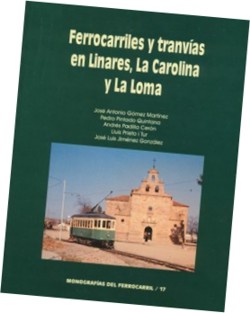 Presentation in the book of Michael Ángel Rodríguez, president of AJAF, Jaen:
" No doubt, the book that you are supporting in your hands comes to do justice to a part of the history of our country forgotten by the majority of the experts of this way of transport. In the already distant XIXth century, the miners and railroad workers of the region of Linares and the rest of the province of Jaen began to write with golden letters a few epic pages in the history of the Spanish railroad. The contribution of the ways of Jaen iron to the railway development of Oriental Andalusia it was basic.
Numerous railway companies put his lines to the service of this transport, arising concerning the mining axis Linares - The Carolina an authentic net of fabric of spider that was crossing it through. The big companies of national area (MZA and Andalusians) and hisbranches (Los salidos - Vadollano) smaller others joined with readiness, as The Carolina and Prolongations with his railroad of metric route, as well as a good number of small railroads and air cables that were serving to the mining developments.
Two railway developments of the zone deserve special mention, Streetcars of Linares and the Electrical Railroad of The Hill, of the limes the first one was born with evident purpose of service to the mines, using as transport of the personnel to his respective wells, as well as of union between the diverse railway stations that the city of Linares had. On August 1, 2004 Streetcars of Linares it will fulfill the Centenary of his inauguration. The extraordinary of these two companies takes root in that both were interconnected, both were served by streetcars and both ended his days together, under the baton of Railroad exploitation for the State, later Feve.
The industry of the province, based on the olive grove, also found in the railroad his better form of transport. Not without reason the railroad of Puente Genil - Zarzuela knew itself Linares as the Train of the Oil. Still today, the Green Route created on his former tracing knows itself for this one the same name.
Rightly it is to remember that the railroad had in the rest of the province other projects. We cannot forget to the Baeza - Utiel, of unlucky memory for the harassed of his history and the painful of his"death". Other tracings were that of Marmolejo to Puertollano, whose works managed to begin, The Carolina to Puertollano, and others of minor entity that they did not happen from mere projects.
For us, fans and friends of the railroad, the lines that furrowed one day the whole province have a great meaning: they brought, from the hand of the mining industry, work and prosperity to our land, and still they would continue bringing it if they had not been eliminated great part of the tracings, after his shameful abandon. Because of it it is so important that this book is published. The collective memory of a society never dies if his recollections are kept fresh in every citizen. The Utopian dream of every friend of the railroad should be that this one work that now has in his) hands could be the base for the return to the life of some closed line. Still being a Utopia, it fits the safety of which he will contribute that this part of our history does not fall down in the oblivion. (...) "
Characteristics
Date of publication: 2004
Language: Spanish
Nº of pages: 408
Authors: Jose Antonio Gómez Martínez, Pedro Pintado Quintana, Andrés Padilla Cerón, Lluís Prieto i Tur, Jose Luis Jiménez Gonzalez.
Size: 21 X 27 X 2 cm.
ISBN: 84-930930-6-8
(SOLD OUT)